|
Strut-channel Panel Rack
There are times when the best location for solar pool heating panels is
not a roof but a rack whether its on the ground, on another surface, or even
just to get some pitch on a shallow-pitched or flat roof. This could be due to lack of available
roof space or poor orientation, concern about roof leaks, distance from pool
equipment, etc., all of which make building a rack a better option.
Before 2005, we would have recommended the use of the all aluminum
GroundPro or ProRack made by a Professional Solar Products in CA. Unfortunately for us and
our dealers, this rack was discontinued by the manufacturer, not because
it wasn't a popular and terrific product, but because demand for it was seasonal
and the manufacturer couldn't afford to keep the required floor space for this
inventory when their PV rack business was booming. They had to make room
somewhere and these racks just lost out. It was an excellent product and
one that some other manufacturer, possibly even
FAFCO, will more than likely take on in the near future.
In the meantime, we have designed a simple, strong, and durable rack
structure that will more than satisfy this void in the pool panel rack market.
Sure you can always build a rack out of wood, but woods has one critical
weakness...it might not last as long as the panels themselves. Durability
is our concern. If you want to build a wood rack, we included a
schematic that is adequate in strength on the
following page. However, we highly suggest that you consider a more
durable alternative made from steel strut-channel. The following
rack is designed for anyone to build, dealer or pool owner. It is a
quality rack structure from components available in your local area. We
want to make it easy for you to install a solar pool heating system. If
you have difficulty finding any components, contact us or your dealer so we can
help you find them.
What is strut-channel?
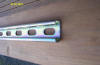
Strut-channel is a channel specifically design for structural uses
and common in both the plumbing and electrical industries. See
pictures below. It is manufactured under many names (e.g. Uni-strut,
Super-strut, Power-strut, etc.) and all are compatible and interchangeable.
It comes in steel, aluminum, and even fiberglass but we recommend steel for
strength that is either galvanized or better yet, zinc/chromate-coated (the gold-colored coating) that makes the strut
extremely durable (even in such corrosive salt-laden environments as Hawaii).
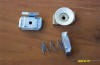
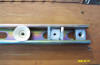
The channel can be interconnected with adjoining connector plates and "strut
nuts" to secure almost anything. From our
lengthy experience in Hawaii and elsewhere, we feel confident in its
ability to withstand the test of time in any geographic location.
However, the main reason we designed this rack using strut channel is that it is literally
available anywhere. It can
be found at any Home Depot, Lowe's, electrical suppliers,
Grainger, etc. It comes in
many sizes and lengths but the most common sizes available at these locations
are 1-5/8" x 1-5/8" x 10' and 13/16" x 1-5/8" x 10' and so these are the members
we will use out of convenience. Either can be easily cut with a hacksaw,
power saw, or miter saw using metal abrasive disk.
|
|
|
|
|
|
|
|
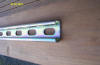
13/16" x 1-5/8" zinc/chromate "gold" strut-channel |
|
|
|
|
|
|
|
|
|
|
|
|
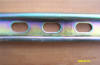
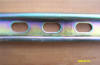
13/16" strut-channel with 1/2" slots (recommended) |
|
|
|
|
|
|
|
|
|
|
|
|
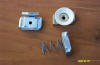
Different types of strut nuts with 1/4" threads |
|
|
|
|
|
|
|
|
|
|
|
|
|
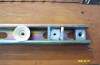
Strut nuts attached to strut |
|
|
|
|
|
|
|
|
|
|
|
|
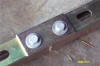
Strut connector plate bolting two channels together |
|
|
|
|
|
|
|
|
|
DISCLAIMER
This Strut channel rack is just a design
concept that we offer as a guide only for a basic rack structure.
Although many of my dealers and their customers have used it successfully to
mount solar pool panels when additional pitch is desired,
ecosystems in no way guarantees its
performance or durability over time since we do not sell
these components or the racks themselves or can verify it was constructed
properly. We haven't done any testing on any aspect of the
components or structure to ensure these can and will withstand the weather, wind
load, or snow load you may experience at your location. Please be advised
that you need to consider such issues when building this rack. It may be
necessary to reinforce this structure as needed. Also, please take every
precaution when assembling the structure to avoid injury.
Building a strut channel ground rack
- Rack location and layout
- Building galvanized "sub-rack"
- Securing angled 1-5/8" x 1-5/8" channel to sub-rack
- Connecting 13/16" horizontal channels
- Securing corrugated sheets to rack
- Securing panels to rack
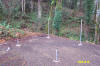
The following pictures are of a three
panel sample rack at our Oregon warehouse. Most racks would be built
to accommodate a larger array of panels depending on geographic location and pool surface
area.
Remember to click on thumbnail
photos for a larger view.
Click here for the
RACK TABLE
to get components list needed to build racks
for different number of panels.
1. Rack location and layout
- It is first necessary to determine where the rack will be located.
Racks can be built on level or pitched ground. Face the panels to the
south or SW for ideal solar collection. You want the rack location to be
free from shade from at least 10am to 4pm daily whenever solar heat is needed.
Generally, 4x12' solar panels are used on rack installation because space is
usually not an issue and 12' panels save time and money since they are
slightly cheaper per square foot and require less mounting components. Once the number of panels
is determined based on the pool size, the rack space can be readily
determined. Figure 52" per panel for the side-to-side rack spacing
and 11' or so for the front to back measurement. If possible, leave walking
space around the rack to access panels as needed. Put stakes at the
corners of your rack area and run a string around the perimeter using a string
level if you want the panels to be square and level.
- We recommend that the ground underneath the rack be cleared of
vegetation so it doesn't grow up to shade the panels later on. Use weed
control fabric or plastic over the dirt and then cover with gravel or crushed
rock. There is some benefit putting white rock in front of rack to
reflect additional solar radiation onto panels, especially during early and
late part of the summer season.
2. Building galvanized sub-rack
- The sub-rack is built from 1-1/4" galvanized plumbing pipe or
"rigid" conduit (do not use EMT conduit) that you can find locally.
You can use 1-1/2" too for a stronger rack. It consist of short
vertical posts in the front spaced every 8-10' (max.) to span the required
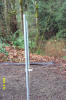
width of the rack. There are longer vertical posts in the back
also at 8-10' apart and roughly 9' to 10' behind the front posts for 12' panels the height of which will
determine the pitch of the rack. It is usually easiest to use one 10'
length of pipe to make both the front and back post (2-1/2' to 3' for the
front and the remaining 7' to 7-1/2' for the back).
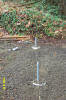
- All posts should be cemented into the ground at least 18-24".
The posts will then be 12-18" out of the ground in front and 5' to 5-1/2' in
back. This give roughly a 25o pitch which works well with
summer heating. Pitch should be somewhere around local latitude less 15o
for summer use and latitude plus 15o for winter use (i.e. Hawaii).
Minimum recommended pitch is 6 degrees for drainage purposes.
|
|
|
|
|
|
|
|
Front posts 9' apart, 18" out of ground in cement |
|
|
|
|
|
|
|
|
|
|
|
|
Longer back posts also 9' apart secure in cement |
|
|
|
|
|
|
|
|
|
|
|
|
Sample three panel rack layout showing front and back posts |
|
|
|
|
|
|
|
|
|
- Once the cement around the vertical posts sets-up, it is time to put a
horizontal member over them. The length of this horizontal member is
relative to the number of panels. The recommended minimum length of this
pipe is # of panels x 52" minus 4'. Example: 6 panels x 52" = 312"
divided by 12 is 26' - 4' = 22' min. These pipes are typically 10'
long, threaded on both ends or with a coupler on one end or readily connected together using a threaded
coupling'.
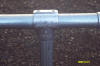
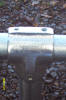
- They are connected to the vertical posts using an special aluminum tee
with set screws. Dealers can purchase these through us or Grainger
Supply (1-1/4" version is part # 4UJ18, 1-1/2" is 4UJ19) Steel
version is available too at a slightly higher price (1-1/4" -- 5A472, 1-1/2"
-- 5A473).
|
|
|
|
|
|
|
|
Aluminum tee holding horizontal pipe to vertical post |
|
|
|
|
|
|
|
|
|
|
|
|
Close-up of tee with three set-screws |
|
|
|
|
|
|
|
|

|
|
|
|
Pipe termination with threaded coupling to add on to if needed |
|
|
|
|
|
|
|
|
|
|
|
|
|
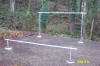
Galvanized sub-rack for three panels |
|
|
|
|
|
|
|
|
|
|
3. Securing
angled 1-5/8" x 1-5/8" channel to sub-rack
- Now that the galvanized sub-rack is complete, you can connect the
angled sections, the "rafters", of the strut rack to it using U-bolts.
However, before you do that, you need to make sure it is long enough for the
panels you are using. The recommended panel size for this rack is 12'
long to this rafter length needs to be 12.5'. Since most available strut is going to be 10' long,
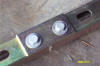
it will be necessary to add 2.5' by using a strut connector plate and 1" x 3/8"
stainless or galvanized bolts to butt connect these two pieces. Be
sure to use washers and lock washers or lock nuts. You may
also want to consider putting another plate on top of the strut channel butt
joints using strut nuts to make it even stronger.
- Now you can connect the
angled strut to sub-rack using U-bolts. U-bolts come in a variety of lengths. They must fit inside the strut
and not extend above the top of the channel itself. Stainless steel
U-bolts seem to be a little shorter than standard U-bolts and are probably a good idea
anyway.
- The accompanying pictures show that this angled member should be located
in the center of each panel. Since then, we have modified the rack
somewhat and so they can be at 4' to 5' apart depending on snow loading. The
closer together they are, the stronger the rack will be.
|
|
|
|
|
|
|
|
Underside of strut showing connector plate with bolts |
|
|
|
|
|
|
|
|
|
|
|
|
|
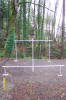
With odd-number panels start in the middle of the sub-rack |
|
|
|
|
|
|
|
|
|
|
|
|
|
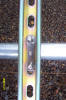
U-bolt secures strut to horizontal pipe of sub-rack |
|
|
|
|
|
|
|
|
|
|
|
|
|
|
|
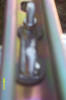
Be sure U-bolt is shorter than top of strut. Use washers and lock nuts. |
|
|
|
|
|
|
|
|
|
|
|
|
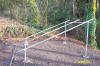
Install all angled member 52" on center. |
|
|
|
|
|
|
|
|
|
|
|
|
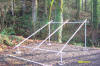
Three angled struts installed for three panels |
|
|
|
|
|
|
|
|
|
4.
Connecting 13/16" horizontal channels
- Once the angled members are installed and securely tightened, start
installing the 13/16" strut to them. You can use the strut connector plates
and bolts to connect 10' section together as with the larger strut for a
stronger rack, however securing these together is not always needed.
- The top horizontal strut should be at the very top edge of the diagonals.
Again, this is a modification of what is shown. The bottom should be
about 6" above the end of the 12' panel. Secure the 13/16" strut to the angled strut using
3/8" strut nuts and 1" bolts with lock washers. Install the
next two channels 2' inside and the fifth one one in the middle. These
will be used to secure the panel strapping.
- Make sure the edges of the horizontal members are wide enough to
accommodate minimum of about 4.25' per panel.
- This completes the actual rack installation.
|
|
|
|
|
|
|
|
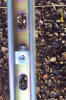
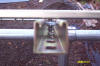
Strut nut inside angled strut member |
|
|
|
|
|
|
|
|
|
|
|
|
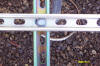
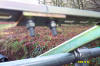
Horizontal strut secured to angled strut |
|
|
|
|
|
|
|
|
|
|
|
|
Side view showing strut nut locked into angled strut |
|
|
|
|
|
|
|
|
|
|
|
|
|
Another view of strut nut holding horizontal strut to angled strut |
|
|
|
|
|
|
|
|
|
|
|
|
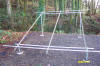
Connector plate holding two horizontal struts together |
|
|
|
|
|
|
|
|
|
|
|
|
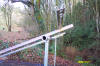
Upper and lower horizontal strut installed |
|
|
|
|
|
|
|
|
|
|
|
|
|
Side view of upper channel |
|
|
|
|
|
|
|
|
|
|
|
|
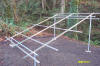
Rack with all horizontal channel attached |
|
|
|
|
|
|
|
|
|
|
|
|
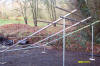
Underside of completed rack |
|
|
|
|
|
|
|
|
|
5. Securing corrugated sheets to rack
- Once the rack is built and before the panels themselves are attached,
we recommend the use of corrugated sheets under the panels to offer more
long-term support. Over time and especially during stagnation periods,
plastic panels will conform to the surface they are mounted to. They
will tend to sage between the 24" and wider gaps between the horizontal strut.
To keep a clean, tight appearance and avoid these issues, lay inexpensive
corrugated fiberglass, or polycarbonate sheets (recommended) under the panels.
Avoid using PVC sheets since they will readily deform with warmer ambient air
temperatures plus the weight of the panels with water.
- Corrugated sheets are available at any hardware or building supply such as
Home Depot, Lowe's, etc. They typically come 8,10, or 12' long and
26" wide so you will need two per panel overlapped to get the
recommended 45-46" in width to fit just inside the panel width. Their
overall length should be trimmed to fit inside the panel header, about
136" for 12' panels. Keep this corrugated material out of UV
radiation if not rated for such exposure. These sheet will also
minimize convection cooling off the back-side of the panels if any wind blows
from that direction. Convection cooling can reduce the performance of
the solar panels.
- For a rack with an odd number of panels lay two overlapped sheets together
and and center them on the rack and
attach them to the rack in two places using 1/4" strut nuts and 1" SS bolts
with fender washers to keep them from sliding out from under the panels.
The panels "belly-band" strapping will secure them along with the
panels.
- Simply drill a hole through the sheet where the nut is located on the
lower outer corner of the two overlapping sheets. Don't tighten just yet
because it may be necessary to shift the sheets around somewhat to fit neatly
inside the panel edges.
- For a rack with even number of panels, place on edge of the two sheets
about 2" from the rack center.
- It is probably easiest to install the first panel now on these sheets
and then install the remaining corrugated sheets under the panels as you go.
Go to section #6 to learn the panel installation procedure.
|
|
|
|
|
|
|
|
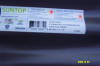
Label on corrugated sheet |
|
|
|
|
|
|
|
|
|
|
|
|
|
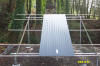
Sheets laying on the rack |
|
|
|
|
|
|
|
|
|
|
|
|
|
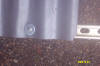
1/4" bolt with fender washer holding sheet to rack |
|
|
|
|
|
|
|
|
|
6. Securing panels to rack
- The following panel installation procedure is in
more detail in the "System Installation" section of this site.
- Lay a panel on the first set of corrugated sheets.
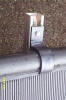
- Slide two ST brackets onto the upper header of each panel. These
first came in a single piece version but now come in a two-piece version.
Place them about 30" apart and secure to the uppermost horizontal strut with a
3/8" strut nut, 3/8" x 1" SS bolt and a lock washer. These brackets are the only thing holding the
weight of the panel, which will be about 70 lbs. with water. It is
very important to tightly secure them to the rack. Now you
can secure the next set of corrugated sheets for the next panel.
- Slide rubber couplers onto all four corners of the panel.
As you can see, this is part of the modifications. Initially, only
one ST clamp was used per panel. It was increased to two to add more
support and strength to the panel mounting.
- Use #40 SS band clamps to tighten the rubber coupler onto the header.
Notice that the "spin-weld" at the end of each header acts as a barbed-end.
This creates a bulge on the rubber coupler. Put the clamp on the panel
side of this bulge. Tighten securely but don't over-tighten or the
clamp will strip. Slide an open second clamp onto each coupler,
slide an ST bracket onto the upper header of the next panel, and slide this
panel header into the coupler on each side of this panel. Tighten the
clamps as before.
- Do this sequence of corrugation first then panel, and so on until all
panels and together and secured with their ST bracket to the rack.
- Square panels to the rack and the corrugated sheets under the panels.
Tighten all bolts. You don't need to put too much pressure on the bolt
holding the corrugated sheets since they are just to keep them from sliding
out.
|
|
|
|
|
|
|
|
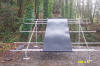
Lay panel on corrugated sheets from center of rack |
|
|
|
|
|
|
|
|
|
|
|
|
Secure upper header of panel to angled strut using ST bracket |
|
|
|
|
|
|
|
|
|
|
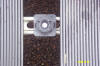
- Connect the base of the tie-down cleat on the ends of and in between each
panel on the horizontal strut two feet up from the bottom header and two feet
down from the top header and the center strut.
- Tie a single knot on the end of the Dacron strap leaving 6-8" of strap
excess on each end of the bank.
- Lay a strap in groove of the tie-down base and hand-tighten the caps as
you go putting moderate tension on the strap each time. At the end of
the bank, cut the strap again tying a knot at the loose end. Do this for
the other two straps. If you need to add onto the strap, tie two
together.
- The rack should be strong enough to stand on but it would be better to
stand on the horizontal sub-rack pipe instead of the horizontal strut.
Be careful with panel edge when you do this. Reach the upper cleats from
a ladder over the top header.
|
|
|
|
|
|
|
|
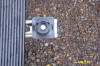
Tie-down base connected to horizontal strut with strut nut and SS bolt |
|
|
|
|
|
|
|
|
|
|
|
|
Tie-down base between panels |
|
|
|
|
|
|
|
|
|
|
|
|
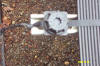
Tie-down bases between panels |
|
|
|
|
|
|
|
|
|
|
|
|
|
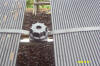
Tie-down base with cap and strap. Note knot is strap. |
|
|
|
|
|
|
|
|
|
|
|
|
Tie-down between panels with cap and strap. |
|
|
|
|
|
|
|
|
|
|
- The panels are now secure to the rack.
- If this rack is in a wind area, it may be necessary to secure the bottom
header more firmly. If so, you can run another strap along the bottom
horizontal strut. This will keep the header from lifting.
- Finally, you can install the panel termination fittings:
- Put coupler on all remaining corners if you haven't already done so.
- You want to feed the panels to the bottom header at the farthest corner.
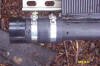
Install a CPVC female adapter here.
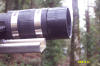
- Put the other female adapter on the opposite, upper corner.
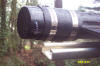
- Install the vacuum relief valve (the end cap-looking thing with two
hole in it) on the other upper corner.
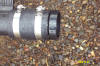
- Install the end cap on the remaining lower corner.
- The panels are now installed and ready for piping to and from the pool
equipment area.
|
|
|
|
|
|
|
|
CPVC female adapter on lower left end of panel bank. |
|
|
|
|
|
|
|
|
|
|
|
|
The other female adapter in upper, opposite corner |
|
|
|
|
|
|
|
|
|
|
|
|
Vacuum relief valve in other upper header - not used in Hawaii |
|
|
|
|
|
|
|
|
|
|
|
|
|
End cap in lower left corner |
|
|
|
|
|
|
|
|
|
|
|
|
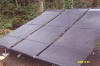
Completed panel installation. |
|
|
|
|
|
|
|
|
|
|